Which Magnesium Form Is Best? Absorption, Not Effect
Glycinate, citrate and oxide differ in absorption and bowel tolerance, not in effect. Compare elemental magnesium per dose before buying any form.
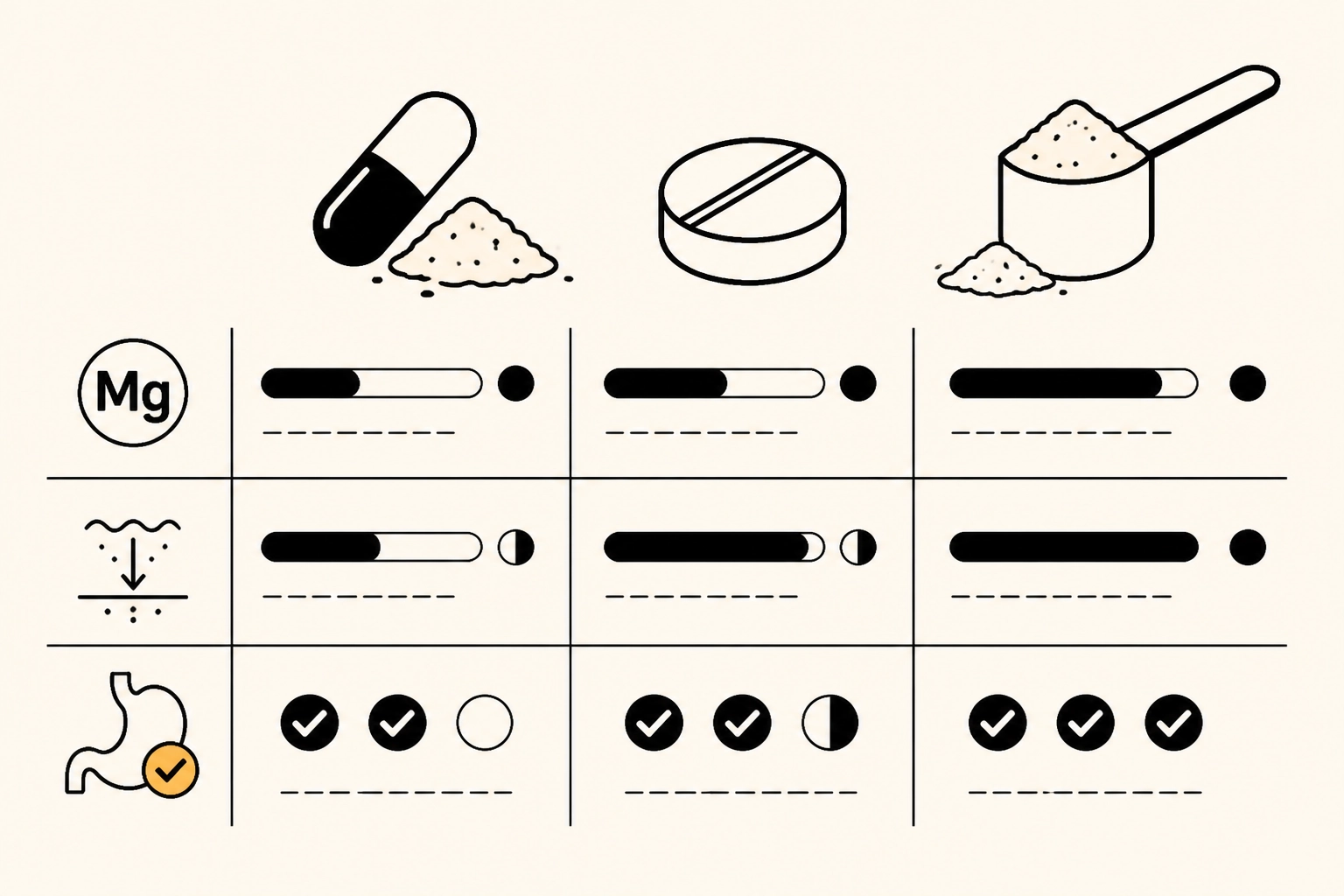
You have probably read that magnesium glycinate calms you while citrate energizes you. That is form folklore, and it needs to go. The truth is more useful: magnesium forms genuinely differ in how much of the mineral actually arrives in your body and how your gut reacts to it. But once absorbed, the ion is the ion. No form delivers a unique benefit. This changes how you should shop for the best magnesium supplement. The decision is not about which marketing name sounds most therapeutic; it is about the dose you can achieve and the side effects you can tolerate. In the sections ahead, we will walk through what every form delivers, how to read compound weight versus elemental magnesium on a label, and the two absorption pathways that set a dose ceiling. We will compare glycinate, citrate and oxide side by side, explain the laxative threshold, examine the 2023 re-evaluation of the 350 mg upper limit, and give you three questions to answer before you buy.
One Ion, One Job: What Every Magnesium Form Delivers

Magnesium's job description does not change with the label. Once a compound dissolves, the body uses the released Mg²⁺ ion as a cofactor in more than 300 enzymatic reactions, including ATP conversion for energy production, DNA and protein synthesis, and neuromuscular function. The magnesium supplement benefits people search for are ion-level effects, not form-level ones.
Three things get conflated in that conversation: the salt printed on the label, the elemental magnesium per dose, and the ion that actually reaches tissue. Only the third one acts. The documented differences between forms sit in how much magnesium arrives and how the gut responds. On the retrieved evidence, no form delivers a distinct benefit.
One caveat belongs in the same breath. That ion-level equivalence is a physiological inference, and none of these sources include a head-to-head trial showing different clinical outcomes by form. Absorption, however, genuinely varies between commercial products, with one in vitro study of 15 formulations finding a very wide variation in dissolution and absorption. The next question is reading the label correctly.
Compound Weight vs Elemental Magnesium: Read the Label Correctly
Once the ion is the target, the label becomes your first decision point. Elemental magnesium is the actual Mg a tablet delivers; the rest of the stated weight is the carrier, whether glycine, citric acid or oxygen.
Elemental share is set by the compound's molecular weight: the heavier the carrier, the smaller the fraction of the stated weight that is magnesium.
The arithmetic matters. Matching compound weight across products guarantees mismatched doses.
Label conventions vary. A product name can describe the compound while the panel reports elemental magnesium, so read the panel before assuming which number you have.
The buying rule: compare elemental magnesium per serving and cost per 100 mg elemental, then check how many tablets your target dose actually requires.
How Magnesium Gets In: Two Pathways and a Dose Ceiling
Reading labels tells you how much magnesium a tablet carries. Getting that magnesium into the body is a separate step. Magnesium crosses the gut wall by two routes: a passive paracellular path between cells and an active transcellular path through TRPM6/7 channels (Schuchardt and Hahn, 2017). Dose behaviour is not linear. Schuchardt and Hahn report that absorbed amount rises as intake rises, but fractional uptake falls, so several smaller doses across the day deliver more total magnesium than one large intake. The food matrix also moves the result: phytate, oxalate, and some fibres impair uptake, while protein, medium-chain triglycerides, and some indigestible carbohydrates enhance it. Fractional uptake falls as intake rises; that is the mechanistic thread to the laxative effect below. On salt type, the full review concludes it appears less relevant than often thought, though some organic salts show slightly higher bioavailability under standardised conditions and the question remains unsettled.
Glycinate, Citrate and Oxide Side by Side
Form | Elemental Mg | Absorption notes | Laxative tendency | Practical use case |
|---|---|---|---|---|
Glycinate | A small share of the compound weight | No form-level data found | Reportedly lowest | Higher doses, sensitive gut |
Citrate | A moderate share of the compound weight | Named more easily absorbed by NIH ODS | Osmotic, loosens stool | Tolerant gut, or bowel effect wanted |
Oxide | A large share of the compound weight | Reportedly least absorbed | Used as a laxative in East Asia | Cost per 100 mg, proven tolerance |
Elemental percentages are arithmetic estimates from compound weights, not label readings. No per-form absorption trial was found.
Neither is better in general. Glycinate is reportedly gentler at higher doses; citrate loosens stool more predictably. The choice depends on your target dose and bowel tolerance, not on a superior effect. The next sections take each form in turn, starting with the one most often chosen by people who want a high dose without bowel surprises.
Magnesium Glycinate: High Tolerability, Lower Elemental Load
Glycinate's gentler profile follows from its structure. Magnesium is bound to glycine, sold as bisglycinate or glycinate chelate, and the elemental percentage is low enough that the label requires checking against the method outlined earlier.
The tolerability reputation has a plausible explanation: a tablet of a given size delivers less magnesium, so less mineral can reach the bowel per dose. Glycine rides along, but no retrieved source tests whether it contributes to the effect. Treat the low loose-stool rate as an inference from dose, labelled as such rather than proven.
That lower load has a practical cost, since a larger elemental dose can require several tablets.
The claim that glycinate calms the brain has no support here. Nothing in this research shows a distinct central effect, so label it unverified, not false.
Best fit: people aiming for higher daily doses who need to stay below their laxative threshold.
Magnesium Citrate: Efficient Delivery, Predictable Laxative Effect
If your priority is more elemental magnesium per capsule, or you actively want a bowel effect, citrate is the alternative.
Magnesium citrate pairs the mineral with citric acid and appears most often in capsules and powders. It appears most often in capsules and powders.
It is widely reported as one of the better absorbed salts, and the citrate carrier is itself osmotically active. That osmotic action does double duty. It supports uptake, but it also pulls water into the bowel, which explains why citrate appears in laxative products at higher doses. MedlinePlus describes magnesium citrate as a saline laxative that retains water with the stool, used short term for occasional constipation.
Treat bowel response as form-specific: the same number of elemental milligrams from citrate and from glycinate is not interchangeable.
Citrate suits buyers who tolerate looser stools, want a bowel effect, or need slightly more elemental magnesium per swallow than glycinate allows.
Magnesium Oxide: Concentrated and Cheap, Least Tolerated
Oxide shares citrate's osmotic mechanism but leaves far less headroom. Oxide packs more magnesium into each milligram of compound than the other two forms, so tablets stay compact for the magnesium they deliver. Oxide is often described as the least absorbed form, though the sources retrieved here include no per-form absorption figures, so treat that ranking as reported rather than proven. In practice, oxide has the narrowest usable dose window of the three. The folklore that oxide is useless overshoots. It delivers the ion; it simply leaves less margin before diarrhoea. Oxide's practical fit: cost-sensitive buyers with tolerant digestion, and short-term use where a bowel effect is acceptable.
The Laxative Threshold: Why Milligrams Are Not Transferable Between Forms
Oxide's narrower window illustrates a broader rule: magnesium milligrams do not transfer cleanly between forms. The reference point is the 1997 Institute of Medicine tolerable upper intake level: 350 mg per day from supplements alone, with diarrhoea as the limiting factor (PMC10509448). That is a population figure for supplemental magnesium overall, not a threshold for glycinate, citrate or oxide individually, so it cannot be assigned to one form. Laxative response moves with the form, the amount taken at once, and food and fluid intake alongside the dose. A practical method is to start below your target, step up weekly, split across meals, and reduce or switch form if stools loosen. Treat persistent loose stools as a signal that you need to adjust the dose, the form or the timing.
Is the 350 mg Upper Limit Still Right? The 2023 Re-Evaluation
That 350 mg figure is not settled, though it remains the reference. Costello et al. 2023 searched PubMed for 1997 to 2022 and found 10 studies, five meta-analyses and five RCTs, of single-ingredient magnesium products with diarrhoea as a prespecified adverse event. Seven reported intakes from 128 to 1200 mg per day. The authors disclose an interest: all authors are affiliated with the Center for Magnesium Education and Research, which argues for a higher limit. This is a perspective, not a guideline. Until it is formally revised, 350 mg per day from supplements remains the reference figure. The 2023 paper opens a scientific question, not permission to exceed the limit, and choosing glycinate, citrate or oxide does not alter that.
What Is the Best Magnesium Supplement? Three Questions Before You Buy
The form debate matters less than three practical questions. First, what elemental dose do you need? Convert every label to elemental magnesium per tablet and per serving before comparing anything. Second, how much bowel tolerance do you have? Choose the form whose laxative threshold sits above your target dose, since that threshold varies by person and product. Third, what does 100 mg of elemental magnesium cost?
Discard marketing shorthand: a product name on the front of the bottle reveals little about elemental content or per-dose tolerance.
The best form of magnesium is the one that reaches your target elemental dose without crossing your laxative threshold.
With those three questions answered, the remaining task is knowing where the evidence stops.
Where the Evidence Is Thin: What the Sources Do Not Show
The shortlist above rests on what the evidence can support, not on what marketing implies. The NIH ODS professional fact sheet was not available to the authors, so form-specific absorption claims here rest on the other cited sources. Absorption research from 2024 onward is still arriving, and the tolerability figures circulating for newer forms remain unconfirmed. Claims that particular forms improve sleep, anxiety or cramps are unsupported by this evidence, which is not the same as disproven. Subex turns papers like these into short evidence-based narratives that mark where the data stops.
Conclusion: Match the Form to the Dose You Can Tolerate
The evidence stops where it stops, so the buying decision is practical: the ion does the work, while the compound decides how much magnesium arrives and how your gut reacts. Glycinate suits higher doses with a gentler gut, citrate suits a looser stool, and oxide suits cost-conscious buyers with proven tolerance. If stools loosen, you have passed your absorption limit: split the dose, lower it, or switch form before adding more milligrams. That is the basis for any best magnesium supplement shortlist.