Why the Anabolic Window Trials Never Isolated Timing
Protein timing trials changed daily intake and meal proximity together, so the anabolic window was never isolated. Track g/kg/day instead.
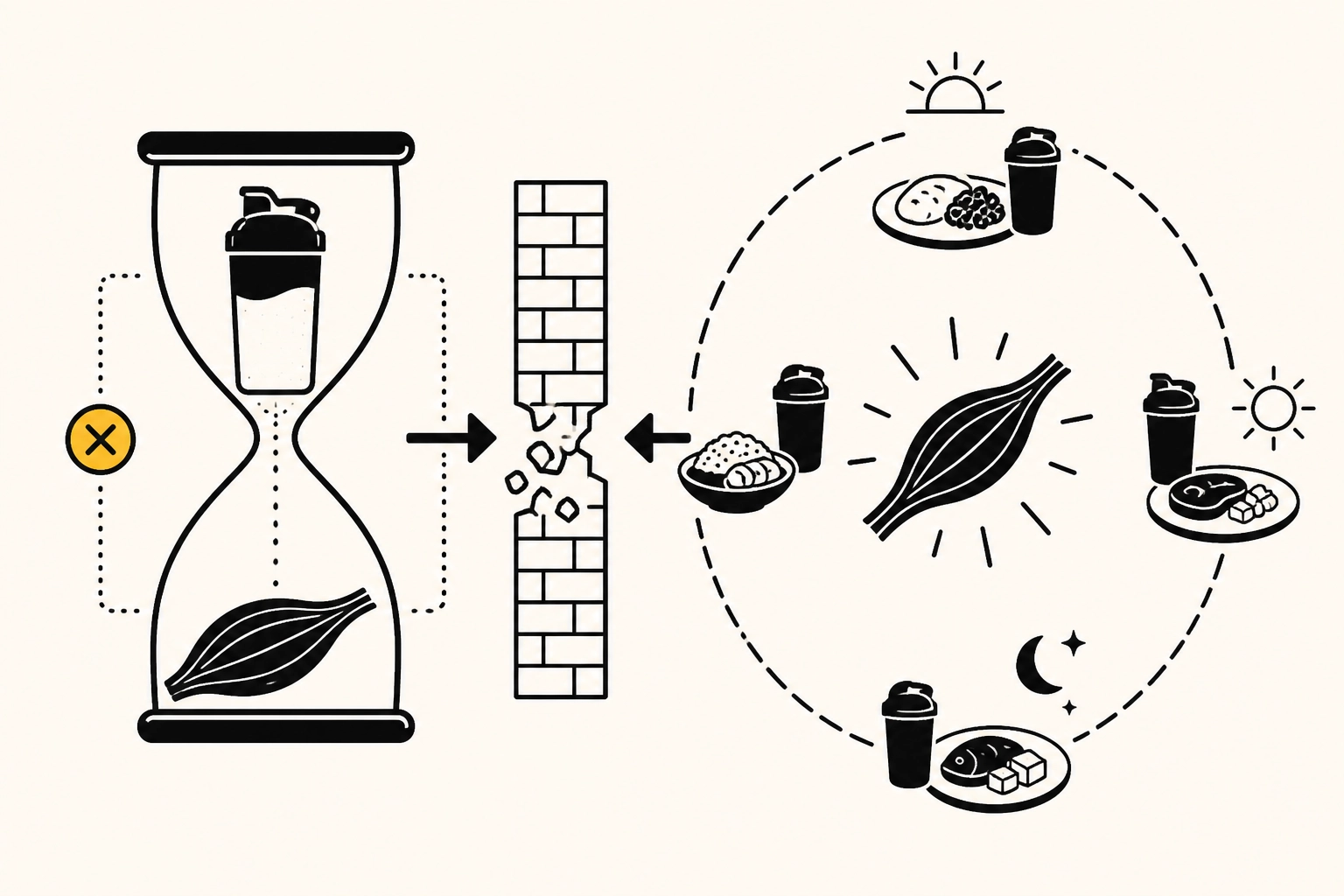
For nearly two decades, the anabolic window has been treated as law in gyms and locker rooms: finish your shake within 30 minutes of your last set, or your training was wasted. That advice rests on a shaky foundation. The foundational studies on protein timing did not isolate timing at all. Most changed daily protein totals and proximity to training at the same time, making it impossible to credit timing for the results. This analysis separates what the anabolic window claimed from what the timing trials actually manipulated, and shows why daily protein intake, not minutes after the last set, is the variable that predicts gains. By the end, you will understand why the practical metric is grams per kilogram per day spread across meals, not minutes after the last set.

What the Anabolic Window Actually Claimed
The folklore came in two versions, and only one was ever testable. The weak claim holds that resistance exercise briefly raises muscle protein sensitivity, an apparent biological plausibility rather than a deadline. The strong claim, the one repeated in gyms, imposes a hard post-set cutoff and warns that missing it wastes the session. That prescriptive clock is falsifiable. The underlying observation never carried the urgency later attached to it. A transient rise in muscle protein synthesis became a deadline, each step adding certainty the original mechanism did not supply.
The framing has proved durable. A Georgia State University page titled “Fact or Fiction: The Anabolic Window,” dated 13 October 2021, shows the concept still being formally addressed in university teaching material long after the question had been reopened in the literature.
The testable prediction is simple. If timing mattered independently, two groups eating identical grams of protein per kilogram of bodyweight per day, with only the proximity of feeding to the last set differing, should diverge in muscle mass and strength. Such a trial would isolate the clock. Most did not.
Underneath the folk claim sits an untested assumption: that the average lifter under-eats protein overall. If that is true, adding a post-workout dose raises daily total, and studies built on that design measure the total, not the timing. The distinction is not pedantic. It determines whether the advice should be a stopwatch or a daily target.
What the Timing Trials Actually Manipulated
Most study designs simply added a post-exercise dose on top of an unchanged daily diet. That one change moved two variables at once. Total daily intake rose, and proximity to training fell in the same arm.
Even trials that tried to control protein often failed at the daily level. Where the arms differ in nitrogen intake, the comparison becomes a total-intake contrast wearing a timing label. The 2013 meta-regression by Schoenfeld, Aragon and Krieger pooled randomised controlled trials and described timing effectiveness as "decidedly mixed"; its strength analysis covered 478 subjects, 96 effect sizes and 41 treatments (Schoenfeld, Aragon and Krieger). Its abstract reports that total protein intake was the strongest predictor of hypertrophy effect size.
Later work has not closed the gap. An 8-week randomised trial in 31 resistance-trained men (average age 24, roughly three years of training, all on high-protein diets) found no effect of timing on muscle mass or strength, as summarised by Examine on 6 August 2024. That summary does not show daily intake was matched by design, so the trial cannot settle the question either.
Why That Design Cannot Isolate Timing
Once you see that pattern, the underlying flaw is easy to state. This is confounding: when two variables move together in every arm of a trial, the outcome cannot be credited to either one.
So what does a pooled timing-versus-placebo estimate actually measure? Mostly the value of extra daily protein, occasionally a proximity effect, with no arithmetic that separates the two. It blends them into one number and calls it timing.
That blending creates an asymmetry the folklore has quietly exploited ever since. A significant pooled effect is fully compatible with a pure total-intake explanation, so it never had to mean what gyms took it to mean. The result was consistent with both stories; only one story got told.
A design without matched daily protein in both arms can speak to protein, but not to timing.
The reporting failure compounds it. A trial that does not publish per-group daily protein intake leaves the reader unable to tell which question it answered, and most gym-facing summaries repeat the abstract without checking for it. Two studies can carry the same title and have tested entirely different things.
That distinction determines what the intake-adjusted evidence below is actually able to show.
What the Evidence Looks Like Once Daily Intake Is Accounted For
Once you apply that standard, the published record is thinner than the folklore implies. The direction of travel is toward smaller timing effects when daily intake is controlled, but that is a premise this article is testing, not a verdict from an abstract.
The load-bearing citation is the 2013 meta-regression by Schoenfeld, Aragon and Krieger, whose abstract calls timing effectiveness "decidedly mixed". Its abstract also reports that total protein intake was the strongest predictor of hypertrophy effect size.
The Nutrients systematic review (volume 17, article 2070) is not cited here as a finding.
What a Well-Designed Timing Trial Would Have to Hold Constant
The screening rule sets the bar: a genuine timing study must hold five things constant.
Matched daily protein. Both arms eat the same grams per kilogram per day, verified by weighed food records or controlled feeding, not self-report. The defensible range for resistance-trained lifters sits around 1.6 to 2.2 g/kg/day (Revisiting Protein Intake in Fitness Training).
Matched training stimulus. Same programme, volume, load progression and session time of day, so the anabolic context differs only by the feeding clock.
Matched meal distribution. Same number of feedings and same protein per meal, with only one feeding's proximity to the session manipulated.
One manipulated variable, properly blinded. An isonitrogenous placebo, blinded outcome assessment and a pre-registered primary outcome, so the analysis cannot drift to whichever measure moved.
Enough power and duration. A small, short trial cannot exclude a modest proximity effect. A definitive trial must be sized by formal power calculation for a small effect, with duration long enough to detect slow lean-mass change. That calculation, not convenience, should set the sample size.
Almost no published timing trial clears all five gates.
The Variable That Actually Predicts Gains
The design critique leaves a practical question: if not the clock, what should you track? The evidence points to total daily protein per kilogram of bodyweight, distributed across several feedings rather than crammed into one. Unlike scoop counts, this metric scales with the athlete.
Be clear about where that figure comes from. The per-kilogram recommendation is drawn from intake literature, not timing trials. A meta-analysis of 49 randomised controlled trials found that protein intakes above roughly 1.6 g/kg/day did not further increase resistance-training-induced fat-free mass gains (Morton et al., 2017). That is a dose-response finding about daily total. It says nothing about minutes after a set.
This is why the daily average beats clock-watching. A missed post-set shake alters one feeding. A week of low intake alters the variable the dose evidence actually measures.
Nothing in the sources here fixes a per-meal number, so distribution stays a reasonable consideration rather than a rule.
In practice, that means tracking a weekly intake average against bodyweight, adjusted for training phase. Track grams per day across the week, not minutes after the last set. The evidence base still has thin edges.
Where the Evidence Is Still Thin
The daily target is the defensible lever, but the evidence base behind it still has edges. The timing trials in view ran for a matter of weeks. That is a short observation window on a slow adaptation, and it is typical: small samples, brief interventions, and outcomes measured before differences could plausibly emerge. The populations are narrower still. Trained adults on high-protein diets dominate the literature, so the null result cannot be generalised to every population. Incentives matter too, and gym-facing summaries rarely check the methods behind a timing finding. Similar selective attention leaves other outcomes unexamined, as in our own review of the B12 trials, where fatigue was the outcome fifteen of sixteen trials never measured. None of this weakens the correction. It strengthens it: track daily grams per kilogram first because that is the conservative reading of the evidence, not the convenient one. The timing claim still has one defensible exception.
Conclusion: Track Grams Per Day, Not Minutes After the Set
Those limitations do not overturn the central reading. The anabolic window was a timing claim, yet the trials meant to test it usually changed daily protein and post-workout proximity together. The design never isolated the clock, so the folklore inherited a conclusion the method could not support.
The practical rule is a daily average. Hit a defensible grams per kilogram per day target, spread across several feedings, and stop treating a hard post-set cutoff as the difference between growth and waste. When judging any new paper, check the methods first. If a timing study does not report per-group daily intake, treat it as a total-protein study with an unusual schedule.
Keep one real exception in view. Training fasted, or after a long gap since your last protein meal, is a different situation. Getting protein in soon after is sensible there, but for reasons the window folklore did not supply.