Memantine Mechanism: Why 'NMDA Blocker' Explains Nothing
Memantine's low affinity and fast off-rate make its effect dose-dependent, which is why it is titrated and why 'NMDA blocker' explains nothing.
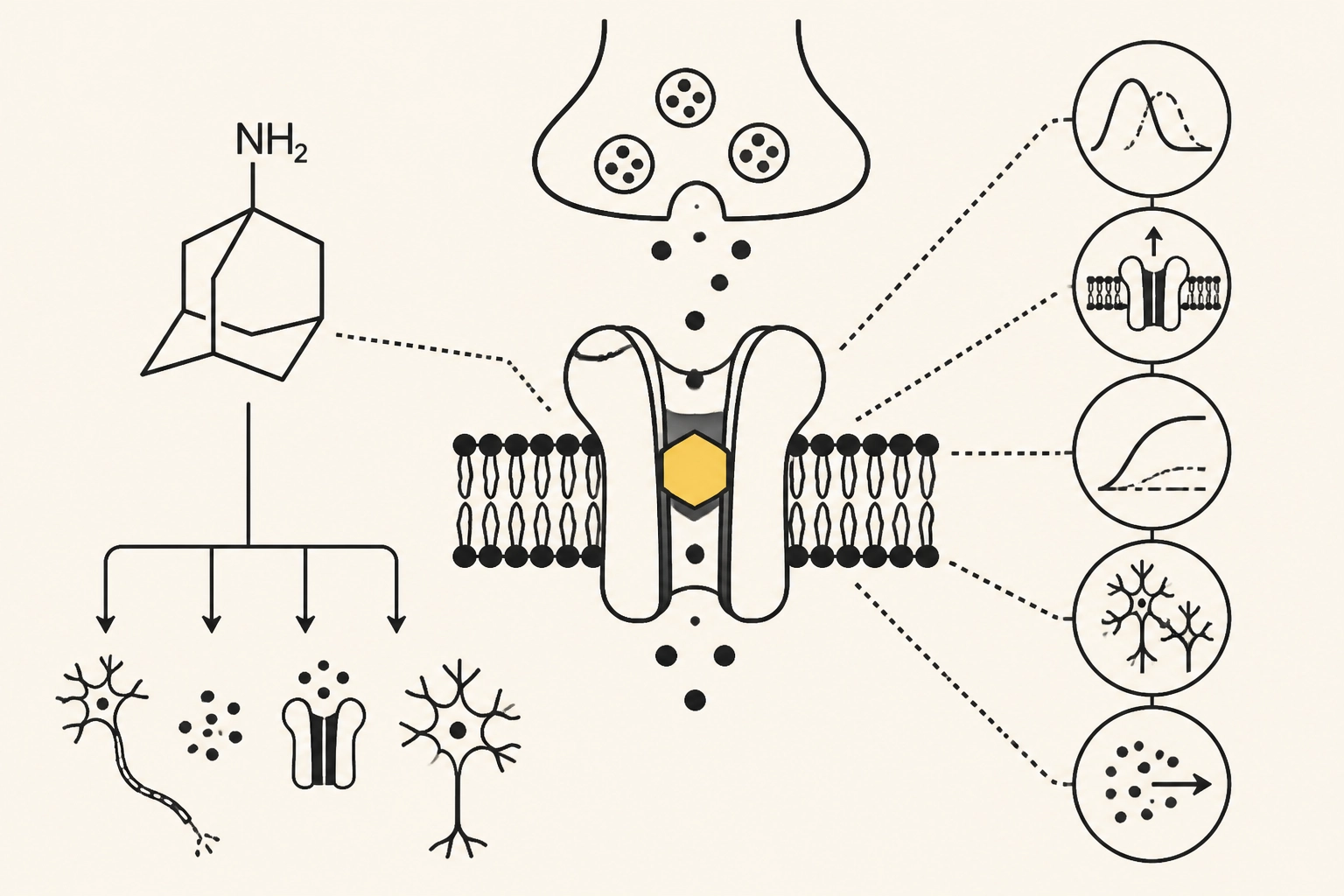
The phrase "NMDA blocker" gets repeated everywhere, from product pages to forum threads, as if it described a clean, predictable effect. It does not. And the gap between that shorthand and what memantine actually does at the receptor is precisely where the useful analysis begins.
This post uses the memantine mechanism of action as a teaching case. The goal is not to defend a label but to read one carefully. You will see how regulatory monographs describe memantine's action at the NMDA receptor; how low affinity and fast off-rate kinetics are argued to make that action possible; and why titration, urine pH, a second receptor target at 5-HT3, and the numbers behind dose-dependent exposure are all part of the mechanism rather than safety footnotes. We will also look at why expert summaries diverge, what combinations with other NMDA antagonists do not predict, and why the clinical effect remains moderate.
Along the way, the broader rule emerges: a receptor name is not an effect. Readers will finish with a more disciplined way to evaluate memantine and every compound marketed on a single pharmacological label.
What the Label Sentence Actually Says About Memantine's Mechanism
The pms-MEMANTINE product monograph hosted by Health Canada describes memantine, with the label's own hedge, as "a low to moderate affinity uncompetitive (open channel) NMDA receptor antagonist, which binds preferentially to the NMDA receptor-operated cation channels," and says it "blocks the effects of pathologically elevated sustained levels of glutamate" (product monograph). The FDA's 2005 label uses near-identical affinity wording, making this regulatory description rather than marketing. Yet FDA highlights use "NMDA receptor antagonist" as the descriptor; the affinity and channel detail sits under Clinical Pharmacology, a section far from the top of the label.
The modifiers carry the mechanism. "Low to moderate affinity" limits channel occupancy. In expert pharmacology, "uncompetitive" denotes binding that requires the channel to be open. "Open channel" names the site. "Pathologically elevated" scopes the claimed glutamate conditions.
Dating caveat: the 2018 FDA label warns it may not be the latest approved labelling, so verify any mechanism or dose quote against current labelling before repeating it as fact.
Partial Antagonist or Open Channel Blocker: When Expert Summaries Disagree
The label wording above is already a compression. The divergence starts earlier, in expert summaries. A 2012 Harvard-hosted review calls memantine a “partial antagonist” in its abstract, while regulatory monographs specify a “low to moderate affinity uncompetitive (open channel)” antagonist. The phrases are not interchangeable. If a peer-reviewed abstract can omit affinity, kinetics and concentration where a monograph supplies them, a one-line product blurb will omit more. Neither term carries dose dependence; both are single-point descriptors. The review's abstract and the monographs agree on what memantine is, not on how much effect follows a given concentration. Neither reports a concentration-blockade curve. That gap is what the rest of this piece addresses.
Low Affinity and Fast Off-Rate: Dampening Without Shutting Transmission
Why Titration Is Part of the Mechanism, Not Just Caution
The 2013 FDA label for immediate-release memantine runs 5 mg once daily, rising in 5 mg increments at intervals of at least one week to an effective 20 mg/day. The 2014 extended-release label sits beside it: 7 mg once daily, 28 mg target, same one-week minimum. Two formulations, two ladders, one logic.
Pharmacokinetics set the pace. The label sets a minimum one-week interval between increases rather than a fixed calendar.
That reframes titration as a walk along the concentration-effect relationship, not a safety ritual. Each step is a level the label allows to be evaluated before adding more, the same margin logic that governs acetaminophen's threshold to toxicity. A low-affinity, dose-dependent blocker requires exactly that walk.
Boundary conditions: these are labelled schedules, not prescribing advice, each belongs to its label year, and current labelling should be checked before any dose is quoted.
Same Dose, Different Exposure: The Numbers Behind Dose Dependence
What the schedules cannot settle is the patient-to-patient spread. The pms-MEMANTINE product monograph hosted by Health Canada reports steady-state plasma concentrations of 70 to 150 ng/mL at 20 mg/day, with large inter-individual variation. Oral bioavailability is high. That near-complete absorption contrasts with compounds where only about 5 percent of a large oral B12 dose is absorbed, a reminder that "dose" and "exposure" are not synonyms.
Renal handling dominates elimination. A Sandoz product monograph lists 75 to 90% excreted unchanged, and the label warns that any rise in urine pH may decrease renal elimination and raise plasma levels. The slogan therefore fails quantitatively. A "blocker" claim without a concentration is unquantified, because identical milligrams can produce meaningfully different exposure. The monographs and labels report exposure variability but no measured ng/mL-to-channel-blockade curve, so the argument remains structural; the same caution applies when acid blockers' 42 percent B12 signal rests on studies that disagree.
Urine pH Is a Mechanism Variable, Not a Footnote
That variability has another input, and it is rarely discussed on product pages: urine pH. The Health Canada monograph states that alkaline urine may reduce memantine's renal elimination by a factor of 7 to 9, raising plasma levels. The FDA labels flag the same variable, which places it inside the regulatory account rather than at the margins. Anything that alkalinises urine therefore raises plasma levels without regard to the milligram figure on the prescription. This is the sharpest rebuttal to slogan style labelling. If a routine, unglamorous variable can shift elimination several fold, a receptor name cannot describe an effect. The label and monograph describe the pharmacokinetic shift only; they report no clinical outcome data for this scenario, so the observation stays at the level of exposure. Next, the molecule hits a second receptor.
The Molecule Binds a Second Receptor: 5-HT3
Urine pH shows exposure is a variable, not a fixed consequence of the milligram dose. The same lesson appears inside the molecule's target profile. The product monograph reports that memantine antagonises the 5-HT3 receptor with potency similar to its NMDA activity. So the drug is not a single-target molecule, even before considering that the same text records low to negligible affinity for GABA, benzodiazepine, dopamine, adrenergic, histamine and glycine receptors and for voltage-dependent calcium, sodium and potassium channels. Selective, yes; single-target, no. A one-receptor label cannot describe a two-target molecule. "NMDA blocker" deletes the 5-HT3 component and any dosing implications that might follow from it. Note the limit: comparable potency is not comparable exposure, and the sources give no clinical consequence for 5-HT3 activity. Even so, this is the cleanest demonstration of the thesis inside memantine itself.

What the Labels Decline to Predict: Combinations With Other NMDA Antagonists
The 5-HT3 point shows a one-receptor label is already incomplete. The extended-release FDA label (revised 2016) adds a further limit: use with other NMDA antagonists, specifically amantadine, ketamine and dextromethorphan, has not been systematically evaluated and should be approached with caution. Read that precisely. It does not call the combinations unsafe; it says the evidence is missing. Receptor-name reasoning invites the opposite guess, that a shared target implies a predictable interaction, and this source set does not support that inference. The label treats these combinations as untested, not unsafe.
What the Mechanism Does Not Buy: A Moderate Clinical Effect
If the labels decline to predict combinations, they are equally candid about effect size. The 2012 review concludes that memantine produces only a moderate decrease in clinical deterioration. That sentence must sit alongside the mechanism story, or the pharmacology sounds more decisive than it is. The same review supplies context: roughly 60% to 70% of dementia cases in people over 65 are Alzheimer’s disease, the population in which memantine is usually discussed.
Mechanism elegance is not effect size. A tidy low-affinity, open-channel profile does not guarantee a large clinical benefit, and the source itself describes the benefit as modest. That caveat belongs in the body, not in a disclaimer. A mechanism explainer that omits effect size is functionally promotional even when every sentence is accurate.
A Receptor Name Is Not an Effect: The Rule Beyond Memantine
The moderate effect size is the honest boundary of the memantine story, but the reasoning travels further. A receptor name omits affinity, off-rate, binding site, voltage dependence, active metabolites, co-targets, and the concentration at which any of it happens. "NMDA blocker" names an address, not a behaviour.
Four questions sort any compound sold on a receptor name:
How tightly does it bind?
How fast does it release?
At what concentration does the effect appear?
What else does the molecule hit?
Memantine answers all four across its label and monograph set: low to moderate affinity, rapid off-rate kinetics, an effect dependent on concentration and therefore titrated in one-week steps, and 5-HT3 antagonism at comparable potency.
So the shorthand is not false; it is non-explanatory. It is accurate at the level of the target and silent at the level of the effect, a category label standing in for a dose-response relationship.
Subex exists to turn papers like these into short, plain, story-driven explanations of what a compound actually does.
Conclusion: Read the Mechanism, Not the Label
Read any "NMDA antagonist" line as a starting point and restore the modifiers that carry the meaning: low to moderate affinity, uncompetitive, open channel, dose-dependent. The labelled titration treats the dose range as the tested ground: 5 mg to 20 mg for immediate release and 7 mg to 28 mg for extended release, each step at least one week apart, per the 2013 and 2014 labels. Twenty milligrams a day does not produce one predictable exposure. Keep the efficacy caveat attached: a moderate decrease in clinical deterioration, not a dramatic one.
Then apply the same four questions to every compound sold under a receptor name: affinity, off-rate, effective concentration and other targets. Check current labelling before quoting any dose. Labels age; mechanisms do not simplify.